Lagos Govt Introduces New Tax Law Allowing LIRS to Recover Unpaid Taxes Directly from Bank Accounts.
The Lagos State Internal Revenue Service (LIRS) has disclosed that a new tax law now empowers state revenue authorities to recover unpaid taxes by seizing funds not only from tax defaulters, but also from the bank accounts of employers, tenants, business partners, friends, and other third parties financially linked to them.
In a statement issued to Lagos residents and business owners, LIRS explained that the Nigeria Tax Administration Act (NTAA) 2025 authorises the service to deduct outstanding tax liabilities from rent payments and from accounts belonging to individuals or entities holding money on behalf of a defaulting taxpayer.
According to the service, the law expands tax enforcement measures beyond a defaulter’s personal bank account where an established tax liability remains unpaid after the due date. This includes direct recovery from accounts of family members, friends, business partners, and other associates who are in possession of, or owe, funds to the taxpayer.
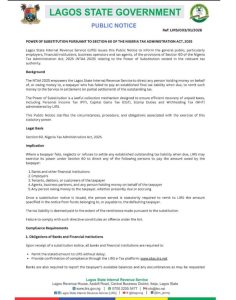

LIRS noted that Section 60 of the NTAA 2025 grants the state the power to issue substitution notices to banks, employers, tenants, debtors, agents, customers, and any person or organisation holding or owing money to a tax defaulter. Such notices compel the identified parties to remit the specified funds to the service in settlement of the outstanding tax debt.
“Where a taxpayer fails, neglects or refuses to settle any established outstanding tax liability when due, LIRS may exercise its power under Section 60 to direct banks and other financial institutions, employers, tenants, debtors, customers, agents, business partners, and any person holding or owing money to the taxpayer to pay the amount owed,” the service stated.
LIRS added that in such circumstances, substitution notices would be issued to the banks of the tax defaulter as well as to financial institutions where third parties connected to the defaulter maintain accounts. Financial institutions are legally required to disclose relevant account balances and remit the outstanding tax amounts to the service without delay.
The development comes amid ongoing efforts by the Lagos State Government, under Governor Babajide Sanwo-Olu’s administration, to strengthen tax compliance and boost internally generated revenue across the state.